
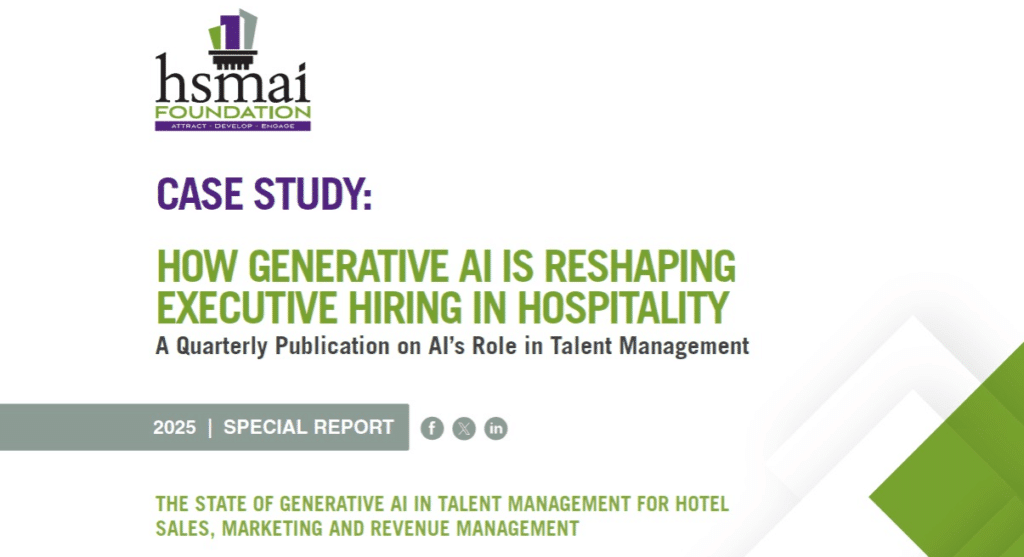
The recently published report “How Generative AI Is Reshaping Executive Hiring in Hospitality” is free and shows an acceleration of up to 80 % in the selection processes.
A new study by HSMAI, a global association dedicated to the development of executives and professionals in the hospitality and tourism industry, with a focus on Sales, Revenue Management, Distribution, and Marketing, reveals that Generative Artificial Intelligence is already redefining executive recruitment and selection processes in the hotel industry, especially in the areas of Sales, Marketing, and Revenue Management. The report “How Generative AI Is Reshaping Executive Hiring in Hospitality”, The report, published by the HSMAI Foundation, analyzes how AI tools are accelerating hiring, expanding access to talent, and transforming the leadership profile required by the sector.
According to the study, the adoption of generative Artificial Intelligence allowed a reduction of 60 % to 80 % in research and development workloads, especially in the stages of market mapping, candidate identification and information organization.
“Automation allows recruiters to focus their efforts on strategic analysis, stakeholder alignment, and quality in the final decision. Furthermore, we eliminate the need to expand teams without losing productivity,” explains Gabriela Otto, president of the organization in Brazil and Latin America.
The research highlights that AI has been primarily used as a strategic support tool, automating operational activities and allowing recruiters to focus their efforts on deeper analysis, client relationships, and aligning executive expectations with organizational goals. The study reinforces that technology does not replace the human factor, but rather enhances decision-making.
Another key point is the expansion of the talent pool. With the support of AI, recruiters can identify high-potential professionals outside of traditional hospitality industry channels, evaluating skills, behaviors, and cultural fit, not just prior experience in similar roles. This approach contributes to more qualified and diverse recruitment processes.
The study also highlights advancements in interview structuring, through the use of more consistent and personalized models for each position. AI assists in creating scripts aligned with the specific needs of each company, increasing comparability between candidates and improving the quality of final decisions.
The report concludes that the adoption of Generative Artificial Intelligence is already yielding concrete benefits for the sector, such as a better fit between executives and their roles, greater clarity of expectations, and improved organizational alignment. For professionals, the message is clear: in addition to experience and training, skills such as digital literacy, analytical capacity, and leadership in hybrid environments of people and technology are becoming crucial for success in contemporary hospitality.
Access the full study HERE.