The report indicates that 84% of managers reported a savings of at least one hour per week, and 70% of sales professionals registered an increase in the conversion rate..
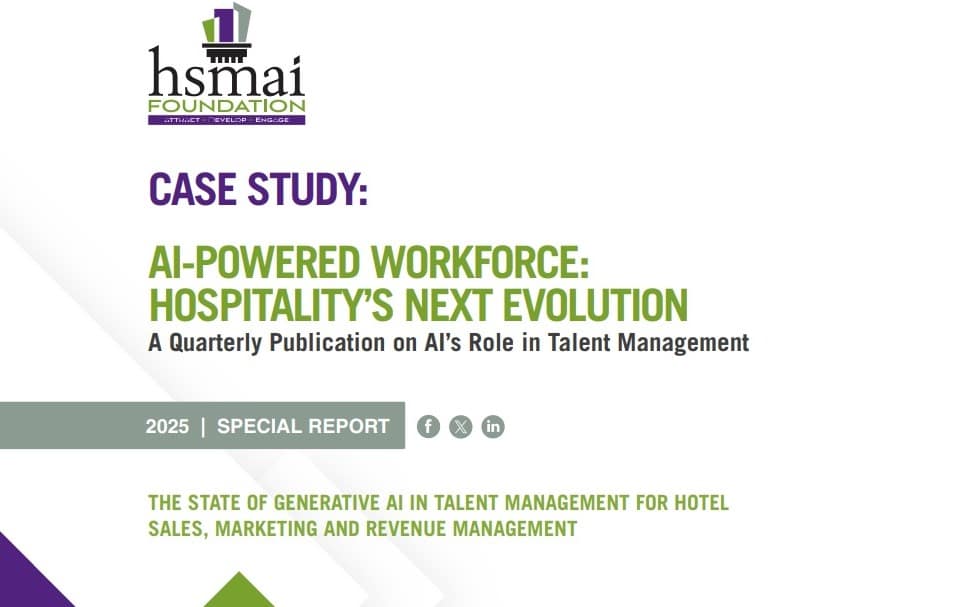
HSMAI, a global association dedicated to the development of executives and professionals in the hospitality and tourism industry, focusing on Sales, Revenue Management, Distribution, and Marketing, presented the study “AI-Powered Workforce: Hospitality's Next Evolution,” which analyzes the role of generative Artificial Intelligence in talent management and development in the areas of sales, marketing, and revenue management within the hospitality sector. The study shows that AI is being used to make professional development more objective, measurable, and continuous, replacing approaches based solely on one-off training sessions or subjective evaluations. The central proposition is that learning should occur “in the flow of work,” integrated into the daily activities of teams.
Among executives, 84% reported a savings of at least one hour per week with the use of AI, time that is redirected to coaching and team development. Furthermore, 83% affirmed an improvement in the quality of coaching, which became driven by data and behavioral patterns identified by the technology.
The study also indicates that 70% of sales professionals perceived an improvement in the partner experience and an increase in closing rates. There was also a 0.3% increase in the success rate of sales presentations, demonstrating that small improvements, when scaled, generate a significant impact in high-volume environments.
“The material shows that Artificial Intelligence is already being used to test and validate specific sales behaviors. Data-backed experiments demonstrated, for example, an increase from 8% to 12% in success when reframing objections, in addition to significant gains with adjustments in language, time management, and sales approach,” explains Gabriela Otto, president of HSMAI Brazil and Latam.
The report, developed by the HSMAI Foundation, highlights that the use of AI reduced the time spent on administrative tasks after sales calls by more than two minutes per call, generating savings of weekly hours per employee and allowing greater focus on strategic activities, such as preparing proposals and relationships with partners.
One of the report's main focuses is the evolution of traditional training toward learning models integrated into daily work, using data and continuous feedback. The study also highlights that, faced with the challenges of digital transformation and labor shortages, AI adoption has ceased to be optional and has become essential to support recruitment, ongoing training, and talent retention.
All the material is open and accessible HERE.